It is surprisingly difficult to answer a very ordinary question: how often is this all happening? Reliable national data is scattered, and overseas figures are often bundled into media stories that make everything feel far more dramatic than the reality. Here is a clear picture of what we know in 2025.
Domestic surrogacy: small but steady growth
Across Australia, around 130 to 150 babies are born each year through domestic altruistic surrogacy. Different sources report slightly different totals, although all fall within the same range.
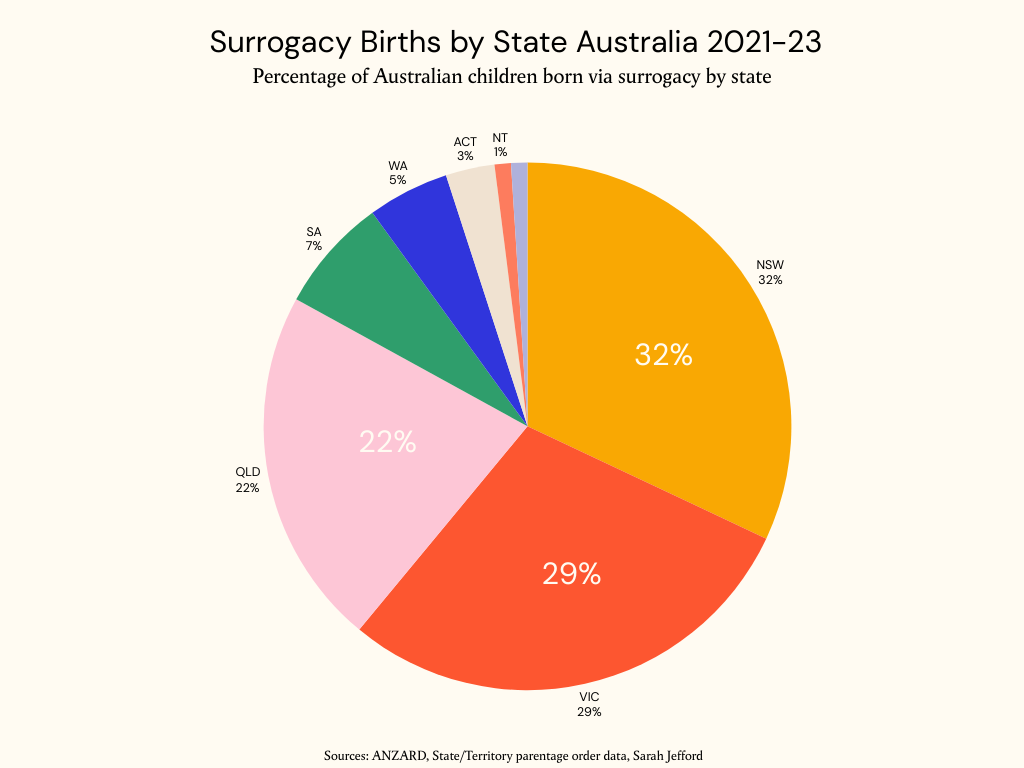
What is much clearer is the distribution. NSW, Victoria and Queensland account for more than 83 per cent of domestic surrogacy births. NSW sits at 32%, Victoria at 29%and Queensland at 22%. These states have benefitted from stable legislation and well-established pathways. Western Australia has fallen behind due to its older and more restrictive laws, although reform is underway.
Adding in the overseas numbers
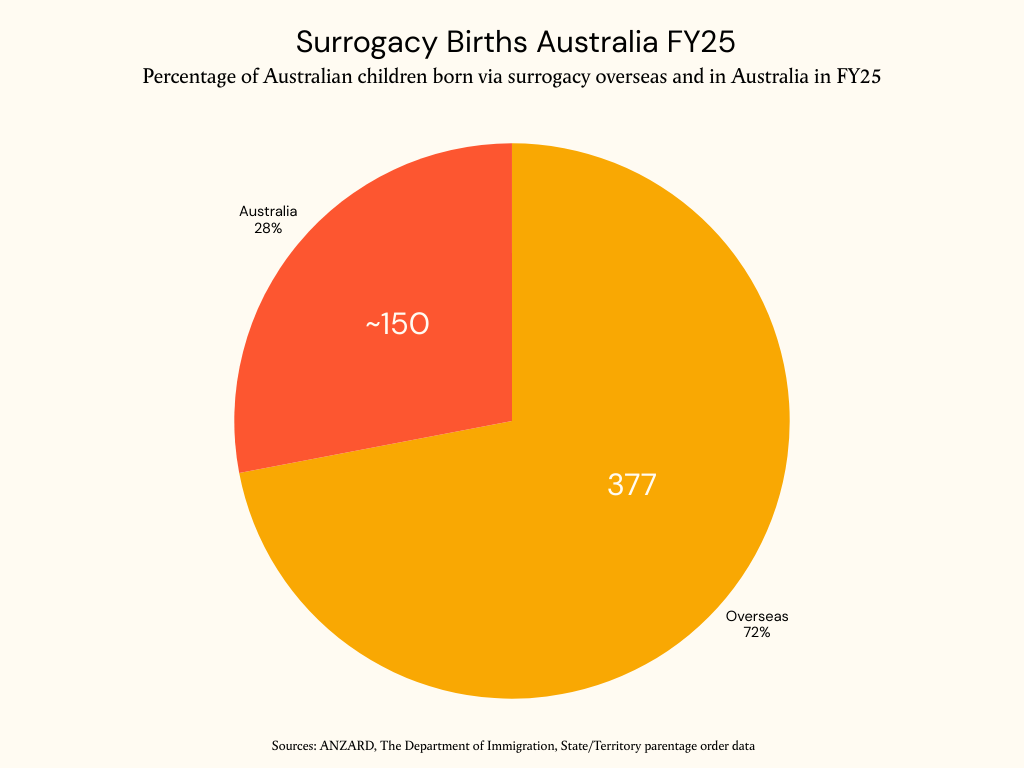
Once you include international surrogacy the national total changes shape. The Department of Immigration recorded 377 Australian babies born overseas in FY25. This brings the estimated overall total to around ~500 babies born each year through surrogacy.
Domestic births still matter, although overseas pathways now represent roughly 72 per cent of all Australian outcomes.
Where Australians are going
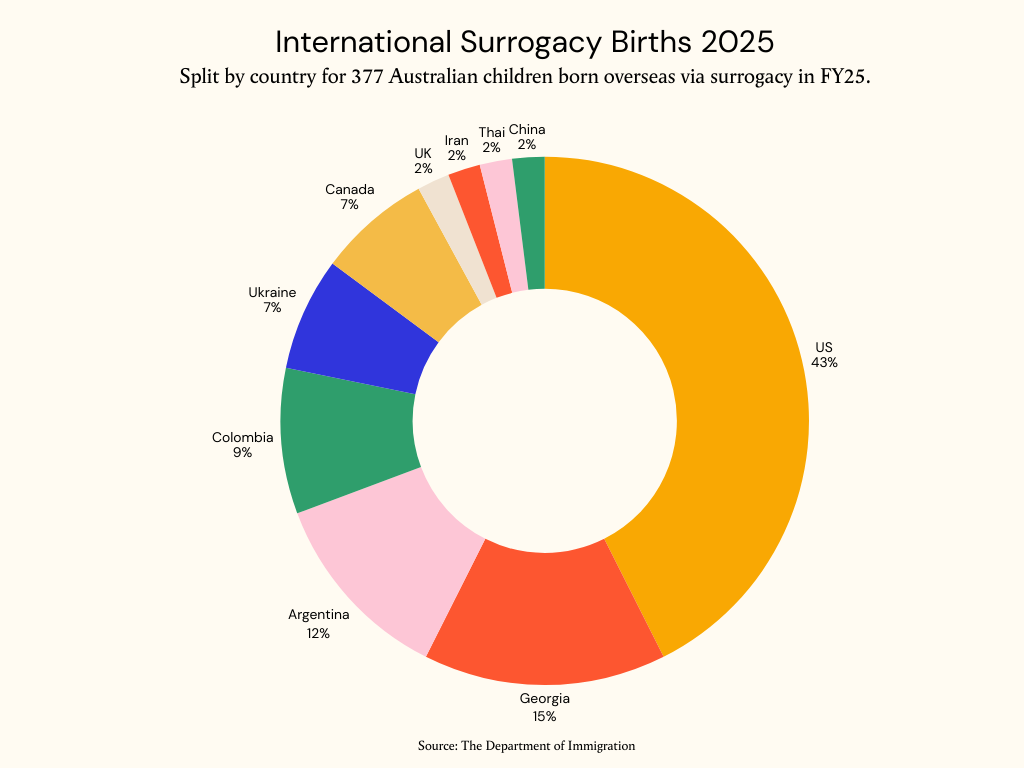
The United States remains the largest destination with 137 births. Georgia follows with 48, although activity has fallen from its recent peak due to uncertainty about access for foreigners. Colombia and Argentina have continued to rise, supported by growing clinic capacity. Ukraine has reduced sharply due to the war. Greece has declined in popularity following regulatory concerns. Canada remains modest but stable with about 7%, supported by a respected ethical framework. It is also one of the models being considered by the Australian Law Reform Commission.
Gestational and traditional surrogacy
Around 95% of Australian arrangements are gestational. Traditional surrogacy is rare and usually appears only within very close family or friendship circles. In recent years there have been fewer than ten traditional arrangements nationally per year.
New connections and existing relationships
Sarah Jefford’s research also shows that around 20% of surrogacy teams are formed through new connections. These often begin in online community groups or through word of mouth. Existing friendships and family relationships account for the remaining 80%. This shift reflects growing awareness and more people seeking to help without an existing personal link.
Family mix
Heterosexual couples with a mum and a dad remain the largest group of intended parents at 63% of domestic arrangements. Two dad couples account for about 34%, and single intended parents represent 3%. International figures reflect a similar distribution, although male couples appear in slightly higher proportions.
Looking ahead
As awareness grows and pathways become clearer, the number of Australian families choosing surrogacy will continue to rise. The stories behind the statistics are becoming more visible, and that visibility will quietly support more people to begin their own journey.
Sources
- Sarah Jefford. 600 Australian Surrogacy Arrangements.
https://sarahjefford.com/600-australian-surrogacy-arrangements/ - Sarah Jefford. Australian Surrogacy Statistics.
https://sarahjefford.com/australian-surrogacy-statistics/ - ANZARD. Assisted Reproductive Technology in Australia and New Zealand.
https://npesu.unsw.edu.au/data-collection/anzard - Department of Home Affairs. Citizenship by Descent statistics.
https://www.homeaffairs.gov.au/research-and-stats/statistics/citizenship-statistics - Queensland Court, Parentage Orders (Surrogacy Act 2010).
https://www.courts.qld.gov.au/ - NSW Supreme Court, Parentage Orders.
https://www.supremecourt.justice.nsw.gov.au/ - VARTA. Victorian Assisted Reproductive Treatment Authority statistics.
https://www.varta.org.au/resources/research-and-statistics